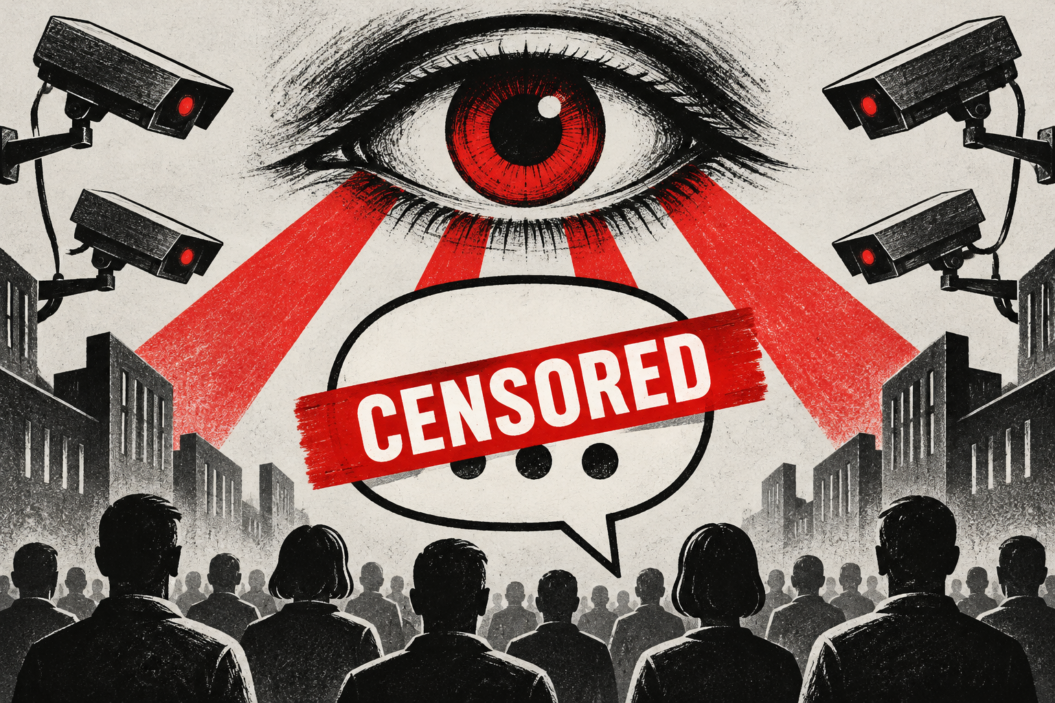
Turkey Is No Longer a Democracy: From Internet Censorship to Digital Identity Controls
I have spent years writing about internet freedom, freedom of expression, privacy and data protection in Turkey. In 2010, I was still asking “Is There Censorship on the Internet?”. In 2011, I was examining internet law and freedom of expression. By 2015, I was writing about network neutrality and the throttling of Facebook and Twitter. We had questions, legal objections and, sometimes, proposals for a different future. I can no longer ask the same questions with the same optimism.
My conclusion is stark: I can no longer describe Turkey as a functioning democracy merely because elections take place and constitutional institutions continue to exist on paper. Internet censorship is not my only reason. The deterioration of judicial independence, press freedom, the right to protest, freedom of association, privacy and meaningful political participation forms a broader pattern. What happens online is the most visible—and increasingly the most technically sophisticated—expression of that pattern.
When I say that freedom is disappearing, I do not mean that every person is physically prevented from expressing every opinion at every moment. I mean something more legally significant: fundamental rights cease to function as predictable and effective safeguards against public power when exercising them depends on administrative tolerance and the willingness to bear serious personal risk. That is my political and legal judgment, not a purported judicial finding.
From exceptional measures to a method of government
Law No. 5651, adopted in 2007, established an internet access-blocking regime justified by the need to address certain unlawful content. Some objectives invoked by governments are legitimate: protecting children, safeguarding privacy and preventing serious crime are responsibilities of democratic states too. But invoking a legitimate objective does not make every means of pursuing it lawful. The essential questions remain whether an interference is necessary, proportionate, transparent and subject to meaningful independent review.
Initially, we argued about blocking entire video platforms and hosting services. Subsequently, restrictions on social networks, the removal of news articles, geographically withholding accounts and deliberate bandwidth throttling became recurrent practices. A state-backed filtering proposal provoked public resistance in 2011. The Gezi protests in 2013 showed how social media could carry news that much of the traditional media failed to report. Twitter and YouTube were blocked in 2014. Wikipedia was made inaccessible in 2017 and reopened only in 2020 following a Constitutional Court ruling.
These were not problems unknown to the courts. In Ahmet Yıldırım v. Turkey (2012) and Cengiz and Others v. Turkey (2015), the European Court of Human Rights found violations of freedom of expression connected with broad blocking orders. The Turkish Constitutional Court’s Wikipedia judgment also made clear that a dispute about particular material cannot automatically justify depriving the entire population of access to a platform. ECtHR, Ahmet Yıldırım · ECtHR, Cengiz and Others · Constitutional Court, Wikipedia.
A further layer of control developed through legislation. Law No. 7253 introduced additional obligations for social network providers in 2020. In 2022, Article 217/A of the Turkish Penal Code criminalised certain forms of publicly disseminating false information and prompted serious concerns about chilling effects on expression. In 2023, the Constitutional Court annulled the access-blocking regime under Article 9 of Law No. 5651 on constitutional grounds, underlining problems with safeguards and legal certainty. Yet the institutional and technical mechanisms of online restriction continued to expand. Law No. 7253 · Turkish Penal Code, Art. 217/A · Constitutional Court, E.2020/76, K.2023/172.
The numbers are no longer abstract
Freedom House classifies Turkey as “Not Free,” scoring it 32 out of 100 in Freedom in the World 2026. Its most recently published Freedom on the Net country assessment, covering 2025, scores Turkey 31 out of 100. These indices are assessments using a civil-society organisation’s methodology, not court judgments declaring the country’s constitutional status. But they help place individual events in a broader perspective. Freedom in the World 2026 · Freedom on the Net 2025.
The Freedom of Expression Association’s EngelliWeb 2025 report, published in 2026, identified 1,505,484 domain names and websites cumulatively blocked from Turkey by the end of 2025, including 232,441 identified during 2025. An important qualification is necessary: many blockings relate to illegal betting and other nonpolitical content, so it would be inaccurate to treat every blocked domain as an independent newspaper or political dissident. Yet the breadth of the powers, the number of authorities exercising them and the prevalence of administrative decisions raise serious questions about accountability. EngelliWeb 2025.
Independent network measurements documented the throttling of major social media services during protest-related periods in March and September 2025. The most troubling aspect is not simply a frustratingly slow application. Restricting communication precisely when the public most urgently needs information affects the right to receive news and participate in debate. OONI technical findings.
The developments of autumn 2026 are still more disturbing. According to monitoring reported in a joint statement by Human Rights Watch, ARTICLE 19, the Freedom of Expression Association and other organisations, Turkish authorities ordered restrictions on at least 1,270 X accounts in September 2026. The reported targets included journalists, independent outlets, rights advocates and, remarkably, accounts documenting internet censorship itself. The same statement raised serious concerns about the blocking of T24, an independent news website, in late September. Joint statement, 12 October 2026.
On 14 October 2026, Turkish authorities appointed a trustee to take over Halk TV amid a criminal investigation, and the broadcaster’s transmission was suspended. The criminal allegations reported by the authorities must be distinguished from an assessment of their merits; yet the effects of taking control of an independent broadcaster on press freedom also require scrutiny. Associated Press.
Protecting children—and introducing identity verification for everyone
The most recent regulatory development brings the question of identity into the foreground. Amendments introduced by Law No. 7578 and the regulation published on 10 October 2026 establish an age-verification framework for social networks. Providers may not offer services to children under 15 and must offer differentiated protections for users aged 15–17. The regulation is scheduled to take effect on 1 November 2026, with a transitional deadline of 31 March 2027 for existing accounts not yet verified through the prescribed token system. Coverage of the regulation · Consolidated Law No. 5651.
Protecting children online is a legitimate and compelling aim. It does not follow, however, that every adult must unquestioningly accept every identity-verification architecture proposed in its name.
Under the new framework, adults as well as minors must demonstrate that they meet the relevant age threshold. The regulation envisages a token obtained through an e-government-linked service. Significantly, the text requires the token not to disclose users’ names, national identification numbers or other directly identifying information beyond the relevant age thresholds. That is a safeguard and should be recognised as such.
But excluding a name from a token is not the same as ensuring that the token-issuing or verification infrastructure cannot track which platforms a person uses. Are tokens single-use? Are they different across platforms? Is an online central-server query required for verification? What event logs are retained, for how long, and who can access them? Some of these technical details remain insufficiently clear in the publicly available legal framework. I have no evidence that a comprehensive state tracking system is already being operated through these tokens. Equally, I have not yet seen independently verifiable evidence that the architecture rules out such linkage.
That difference matters. Privacy is not guaranteed by a reassurance from a public authority. It requires enforceable design constraints, transparent standards, audits and effective remedies. The European Commission’s age-verification blueprint specifically aims to separate the issuer of age credentials from subsequent online use and to prevent linkability across services. Different jurisdictions are exploring different solutions; child safety does not, by itself, settle the privacy debate.
Anonymity is not a privilege granted by the state
Anonymity is sometimes presented as a shelter for wrongdoing. It can also be a condition for ordinary people to speak at all: to ask about sexuality, health, family, religion, work or politics without fear of retaliation. Anonymity is not absolute and legitimate investigations may justify carefully defined intrusions. But normalising a state-linked identity gate for access to everyday conversation should concern anyone who values freedom of expression.
In my 2011 master’s research, I argued that the right to anonymity would become increasingly indispensable in a world drifting towards authoritarianism. I wish that concern had proved exaggerated. Today, the ability to ask a question without publicly identifying oneself is often not about hiding from society; it is about being able to participate in it.
Articles 13, 20, 26 and 41 of the Turkish Constitution provide a framework in which legality, proportionality, privacy, expression and protection of children must be assessed together. Invoking one protected interest cannot erase the others. The European Convention on Human Rights adds obligations relating to private life and expression under Articles 8 and 10.
A ballot box alone cannot make a democracy
Democracy is not just the formal organisation of elections. It requires public power to be restrained by law; courts capable of resisting executive pressure; independent journalism; meaningful political competition; freedom to organise, protest and dissent; and effective mechanisms to challenge rights violations.
No democracy treats expression as unlimited. There are legitimate restrictions against child abuse, serious crimes and other harms. The relevant distinction is whether power invoked for a legitimate purpose remains limited, accountable, necessary and proportionate, or becomes a permanent method of managing society.
Years ago, journalists would ask me whether Turkey’s internet would become like that of Iran or North Korea. These are not identical political or technological systems, and literal comparisons often obscure more than they explain. The urgent question is not which country Turkey resembles. It is which freedom we are expected to surrender today, and which one tomorrow.
I may personally refuse to connect my participation in ordinary online discussion to a centralised identity-verification system. I do not accept that this should mean excluding myself from public life. The purpose of law is to safeguard individuals against the asymmetric power of the state—not to make that asymmetry ever more complete.
So I no longer think it is enough to ask, “Is the internet free in Turkey?” The more important question is whether the rule of law, judicial independence, a free press and genuinely enforceable fundamental rights survive as meaningful constraints on power. My answer, based on the accumulated evidence and my experience, is no. This is not a declaration that defending freedom is pointless. It is an insistence that we finally describe the scale of the problem accurately.
This is a personal legal and political commentary. Uncertainties about how the 2026 age-verification architecture will work in practice should not be confused with established findings of surveillance or misuse.
Further reading: A Chronology of Internet Censorship in Turkey, 2007–2026.
Türkçe okuyun: Türkiye Artık Bir Demokrasi Değil: Sansürden Kimlik Doğrulamasına.